
A bracelet looks simple, but comfort and longevity depend on details that product photos rarely explain. Material, closure, scale and fit determine whether a piece becomes an everyday favorite or stays in a drawer. This guide focuses on those practical decisions.
Start with the material
Solid gold and platinum are durable premium choices, while sterling silver offers a cooler tone at a lower price and may tarnish over time. Gold vermeil usually means a thicker gold layer over sterling silver; ordinary gold plating can use a thinner layer over another base metal. Product descriptions should identify the base metal and plating, not only use a color name such as “gold tone.”
Stainless steel can be a practical everyday option because it is relatively resistant to tarnish. Beaded, cord and leather bracelets create a more casual effect but have different water and wear limitations. If you have metal sensitivities, ask for the exact composition rather than relying on “hypoallergenic,” which is not a universal guarantee.
Measure for fit
Wrap a flexible tape around the wrist where the bracelet will sit. For a close fit, add roughly 0.5–1 cm; for a relaxed fit, add more according to the design. A wide cuff needs different clearance from a fine chain. Charm bracelets also need room for the added volume and weight of charms.
Check whether the listed length includes the clasp. For cuffs and bangles, inner diameter is more useful than total circumference. A bracelet should move without sliding over the hand or pressing into the wrist.
Match scale to the outfit
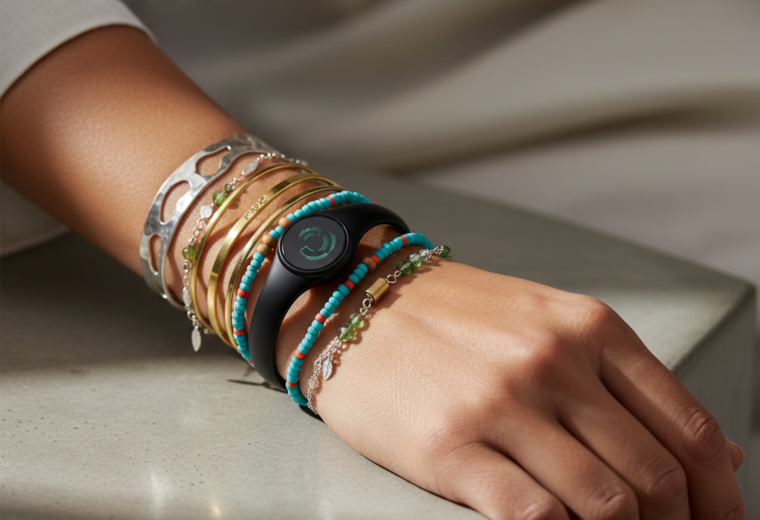
A single sculptural cuff can carry a minimal outfit. Fine chains layer well, but vary the chain styles or thicknesses so the group looks intentional. When sleeves have strong volume, a bracelet may disappear or catch on fabric; earrings or a necklace can be a cleaner focal point.
Use color and finish to connect jewelry to the outfit rather than matching every piece exactly. Repeating one element—such as silver hardware, a pearl accent or a black cord—is usually enough. Explore more wardrobe ideas in our Fashion archive and practical purchases in Shopping & Guides.
Check the closure
Lobster clasps are secure but can be difficult to fasten one-handed. Toggle clasps are decorative and easy to use, although they need enough weight and length to stay closed. Magnetic closures are accessible but may separate during vigorous movement. Hinged cuffs should open smoothly without visible stress at the hinge.
Care for the actual material
Remove most bracelets before swimming, showering, exercising or applying fragrance and lotion. Wipe pieces with a soft dry cloth and store them separately to limit scratches. Follow brand-specific instructions for plated jewelry; aggressive polishing can remove the surface layer.
For fine jewelry, inspect clasps and stone settings periodically. Repairing a loose connection is cheaper than replacing a lost bracelet. Keep receipts and material descriptions because they are useful for future servicing.
Buy for repeat wear
The most versatile bracelet is not necessarily the plainest. It is the one whose material, closure and scale fit your real routine. Before buying, picture three outfits you already own and one ordinary day when you would wear it. That small test is more reliable than purchasing only for a trend image.